 The Alice Pieces of David Del Tredici
By Frank J. Oteri
Championed by conductors ranging from Michael Tilson Thomas and Leonard Slatkin to Sir Georg Solti, Oliver Knussen, and even Aaron Copland, the “Alice Pieces” of David Del Tredici, composed over the course of 25 years, form a fascinating musical journey which directly led to our current pluralistic, genre-blurred sound world of the 21st century. This unprecedented series of musical compositions also trace the evolution of the aesthetic path of their composer whose musical style radically transformed during the process of their creation. The Victorian child fantasy world of Lewis Carroll’s cherished 1865 novel Alice’s Adventures in Wonderland and its 1871 sequel Through the Looking Glass, and What Alice Found There have inspired a broad range of composers and popular musical groups ranging from Deems Taylor, Irving Fine, and Unsuk Chin to Chick Corea, Jefferson Airplane, and The Beatles. But these books and the numerous hidden meanings of passages contained within them (as explicated by Martin Gardiner’s Annotated Alice) have arguably had their deepest impact on Del Tredici. Like Gustav Mahler, whose obsession with a collection of German folk poetry called Das Knaben Wunderhorn led him to compose a series of treasured epic symphonies and song cycles, Del Tredici found an equally nurturing and seemingly inexhaustible musical universe in Carroll’s satiric word-play and idiosyncratic proto-surrealism, one which led him away from the 12-tone serialism that was de rigeur for composers of his generation and which ultimately led him to become the progenitor of the Neo-Romantic movement, reintroducing unabashed tonality back into the lexicon of contemporary classical music.
None of the large scale Alice pieces that Del Tredici has created sets Carroll’s texts as a linear narrative. Rather, each is a musing on individual passages in the books. The music further explores the numerous layers of emotional and psychological underpinnings contained in Carroll’s often cryptic words. It is as if Del Tredici has put a giant zoom lens on select pages from these books, and in so doing, allows us to experience them in a completely new way. In the very first of these pieces, Pop-Pourri from 1968, Del Tredici creates appropriately angular melodies for Carroll’s famous nonsense poem “Jabberwocky” and the parody song “Turtle Soup.” But he is already subverting the atonality of his own music by juxtaposing those settings with an almost monotonal setting of the Litany of the Virgin Mary (taken from the Liber Usualis of the Catholic liturgy) and the inclusion of the Lutheran chorale “Es ist Genug,” directly lifted from Johann Sebastian Bach’s setting in his cantata O Ewigkeit, du Donnerwort (BWV 60). Bach’s famous chromatic melody was also used by Alban Berg in his Violin Concerto, another work which straddles dodecaphony and romantic tonality. In addition to an amplified soprano, mixed chorus, and symphony orchestra, there is a rock band consisting of two saxophones, an electric guitar and electric bass, both with period wah-wah pedals. The young Del Tredici was mesmerized by the rebellious freedom of rock, but ultimately that fascination proved to be short-lived. Pop-Pourri, is the only one of the Alice pieces featuring such an ensemble and the only one to feature a collage of texts. Still, this psychedelic postmodern cantata—which was the first work of Del Tredici’s to contain recognizably tonal music (though he did not actually compose this music)—did open up a Pandora’s Box. For the next fifteen years, every single note of Del Tredici’s music was composed in response to Lewis Carroll’s texts, the music growing more tuneful and more expansive in each successive work. And for a decade after that, although he composed a few additional pieces that were not related to Alice in any direct way, he continued to explore this material, both as the basis for solo and chamber compositions as well as the largest scale composition in his entire output, Dum Dee Tweedle.
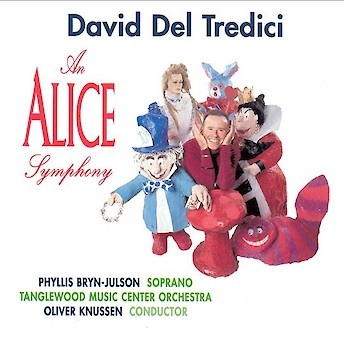
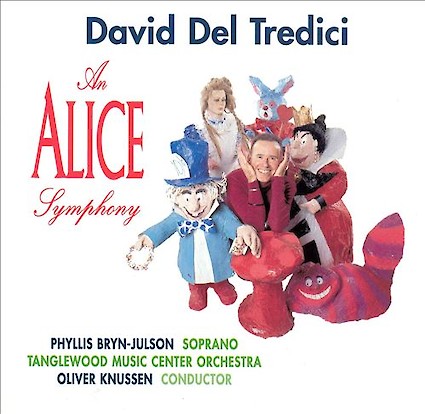
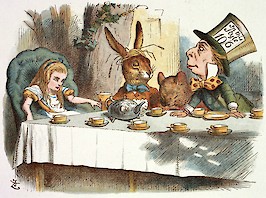 The next of the Alice pieces hints at Del Tredici’s ultimate musical ambitions. He calls his four-movement, forty-minute work from 1969, An Alice Symphony. While Del Tredici acknowledges that the work is not a symphony in any conventional sense, he wanted this material to have “the dignity of a symphony” and indeed it does. Symphonies historically consisted of a series of different movements contrasting tempo and mood. In An Alice Symphony, Del Tredici also presents contrasting musical material, but here instead of parsing different kinds of music into different movements, seemingly disparate moods and styles are directly layered on top of each other, all in the service of the texts which govern the shape of each movement. Scored for amplified soprano/narrator and an orchestra enhanced by a “folk group” consisting of two saxophones, mandolin, banjo, and accordion, the music prominently features a 12-tone row, but there are also clear tonal elements, now consisting of originally composed diatonic music (though these tend to be harmonized through a scrim of “wrong notes”). One of the most surreal aspects of An Alice Symphony is the way it begins and ends with the tuning of the orchestra—a utilitarian rather than a functional pitch centrality which serves to take the listener into Wonderland and back out again. Heard in it’s entirely, An Alice Symphony is a poly-stylistic tour-de-force. The work has had a complex, though illustrious performance history. Illustrated Alice (mvmts 1 and 4) was commissioned and premiered by the San Francisco Symphony. In Wonderland (mvmts 2 and 3) was premiered at the Aspen Music Festival. The first performance of The Lobster Quadrille (the Symphony’s second movement) featured the London Symphony Orchestra conducted by Aaron Copland, one of Del Tredici’s mentors. An Alice Symphony did not receive its first integral performance until Oliver Knussen conducted it at Tanglewood in 1991 with Phyllis Bryn-Julson as soprano soloist (after which it was subsequently issued on a commercial recording).
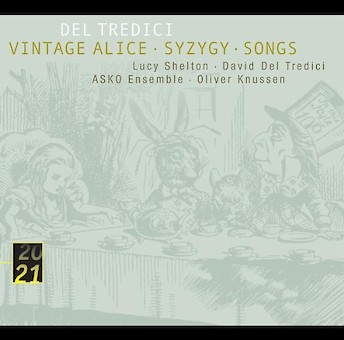
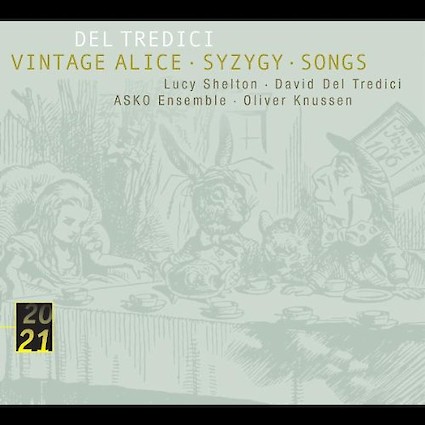
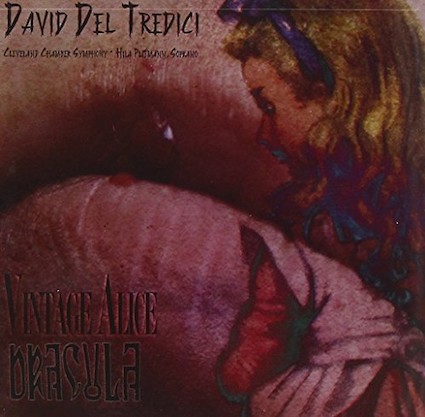
There are still undeniably atonal passages in Del Tredici’s two subsequent, similarly-scored compositions: Adventures Underground (1971 revised 1977) and Vintage Alice (1972). (It should however be noted that only a chamber orchestra is needed for Vintage Alice, a work commissioned by the Paul Masson Winery—hence the title—which was first performed on the winery’s grounds in 1972 by an ensemble led by the composer.) Michael Tilson Thomas and the Buffalo Philharmonic commissioned and premiered Adventures Underground in 1975. The work includes a setting of Carroll’s “Mouse’s Tale” whose words were printed in the original publication to resemble an actual mouse tail. Del Tredici took this as a cue to create one of the most stunning examples of augenmusik in the orchestral literature: a series of tails which—in the score—stretch across 36 staves from the piccolos to the double basses and which sound appropriately like the slinkering movements of actual mice, albeit at a much louder volume. Vintage Alice is chock full of tonal allusions. Two immediately recognizable tunes, “Twinkle, Twinkle, Little Star” and “God Save the Queen,” get mangled in uproarious send-ups that are simultaneously in three keys at once. While this music is still quite far away from the lush tonal melodies that Del Tredici would subsequently write, he has already escaped the straitjacket of the tone row in this freely polytonal music.
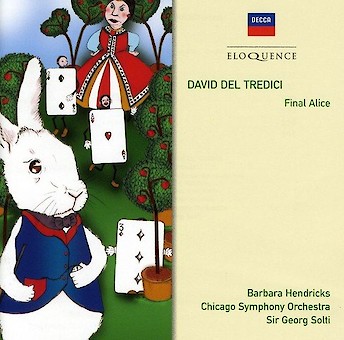
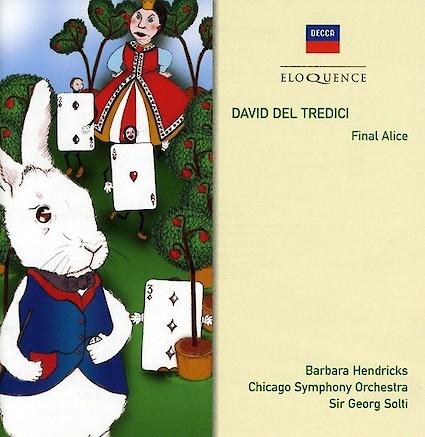
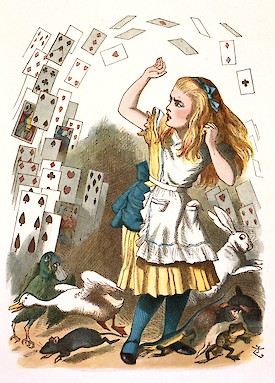
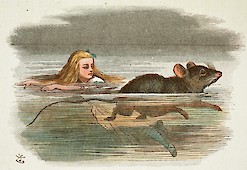 It was not until Del Tredici’s subsequent, much larger scaled Final Alice—first performed in 1976 by Barbara Hendricks and the Chicago Symphony Orchestra under the direction of Georg Solti—that Del Tredici hints at a full flowering of a completely functional tonal musical dialectic. Elements from Del Tredici’s earlier music syntax still appear—fairly early on in the piece there is actually a full statement of a 12-tone row (the same one that appeared in An Alice Symphony) that is then permuted and transposed as per established serial procedures, despite resolving cadentially soon thereafter. But now infectious diatonic melodies take center stage. The work consists of a series of arias and orchestral elaborations on them. The texts are depositions of evidence in the trial of the missing tarts. Some of the poems contained in Carroll’s texts are parodies of well-known Victorian poems which hint at darker meanings. Many scholars have interpreted these allusions as evidence that the Rev. Charles Lutwidge Dodgson (the real name of Lewis Carroll) harbored romantic feelings for 10-year-old Alice Pleasance Liddell, the young girl who inspired him to write these stories. To Del Tredici this forbidden love was best represented by unabashed tonality. As he put it, “the scrim of wrong notes never came.” But he was terrified that he would be ridiculed for writing music “forbidden” by the musical establishment. However, the unforgettable, hauntingly beautiful vocal lines in Final Alice, particularly the final aria, “Acrostic Song,” brought Del Tredici almost instantaneous success, both in terms of critical acclaim and notoriety among the general public. Within four years of its premiere, the hour-plus Final Alice received performances by 10 additional American orchestras (among them the Boston Symphony, the Cleveland Orchestra, the Los Angeles Philharmonic, the Minnesota Orchestra, the New York Philharmonic, the Philadelphia Orchestra, and the St. Louis Symphony). Seven of these performances were nationally broadcast on radio and one was even televised! The Chicago Symphony’s recording of the work, released in 1981 on a Decca LP, became a best-seller.
Recent & Upcoming Alice Events
 Pop-Pourri in Albany June 2019 6/1/2019 08:00 PM
 Adventures Underground 6/2/2018 07:30 PM
 Crested Butte 8/3/2017 6:00 PM
Recent Alice News
 Child Alice complete recording by BMOP 11/15/2017
 BMO Kickstarter Funds Child Alice 5/13/2016